
Shareerik (Physical Development)
Understanding Achar Paddhati in Sangh Shakha
Achar Paddhati refers to the formal set of practices observed at the beginning and end of a Sangh Shakha (branch gathering). In any organization with a widespread presence, it becomes essential to adopt standard procedures for shared programs—and Achar Paddhati serves this purpose for the Sangh.
While Sangh functions as an organization, at its heart, it is a family—built upon informal, yet deeply meaningful, relationships among swayamsevaks and sevikas. They unite in spirit and action under the shared mission of Vishwa Mangala Hetave (for universal welfare) and Vishwa Shanti Pravartake (one who promotes global peace). Shakha is a space where Sanskar-oriented and wholesome activities are conducted for the physical, intellectual, and emotional development of participants. At its center stands the Bhagwa Dhwaj, revered as the Guru of the Sangh. This saffron flag symbolizes Dharma and culture, embodying the values of purity, wisdom, and sacrifice. Its presence transforms the Shakha-sthan (venue of Shakha) into a sacred space of learning and discipline.
Members arrive at Shakha from various personal and professional commitments, each carrying different thoughts. The Achar Paddhati at the start of Shakha helps center our focus, creating a unified mindset ready for collective engagement. It instills discipline and structure, ensuring that each gathering is purposeful and harmonious.
At the conclusion of Shakha, Achar Paddhati serves as a moment of reflection and reverence—paying homage to our Guru, the Bhagwa Dhwaj, and honoring our cultural and spiritual heritage. It also reinforces our current responsibilities toward society and Dharma. The collective atmosphere—especially during the prarthana (prayer) and the reaffirmation of our oath—evokes a deep sense of unity with purpose.
Thus, it is vital that every swayamsevak and sevika not only follows Achar Paddhati with sincerity, but also understands its deeper significance. Through consistent practice, it becomes not just a tradition, but a lived expression of our values and commitment.
Shakha formation sketch
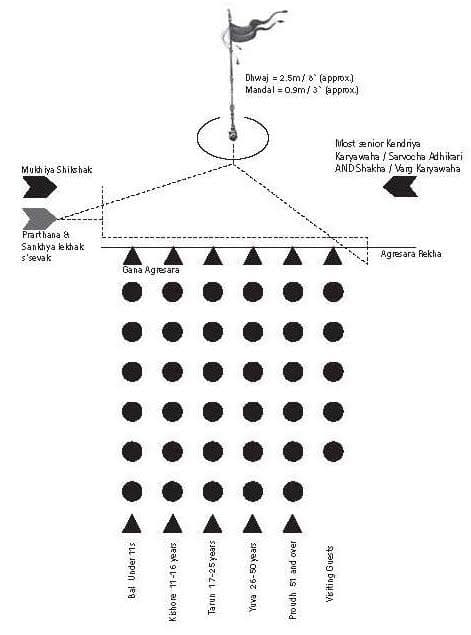
Shakha starting and concluding Agnyas
| Shakha Starting |
|---|
| Whistle (one long one short; one long one short) / Sangh Swasthan |
| Sangh Daksha |
| Arama |
| Agresara |
| Agresara Samyak |
| Agresara Arama |
| Sangh Sampata |
| Sangh Daksha |
| Sangh Samyak |
| Agresara Ardha Vruta |
| Sangh Arama |
| Sangh Daksha |
| Dhwaja Pranam-Ek, Do, Teen |
| Sankhya |
| Arama |
| Sangh Daksha |
| ↓ Mukhya-Shikshak conveys the Sankhya to the Karyavah and returns back ↓ |
| Arama |
| Sangh Daksha |
| Swasthan |